


Conformity has always been a double-edged gift. It is the reason humans survived when other species fell away. Shared rituals, shared language, shared rules allowed tribes to coordinate and protect. But the same instinct that binds us into community also chains us into obedience. Morality, too often, has been nothing more than conformity sanctified.
The Origins of Moral Obedience
In early societies, deviation from the group was death. To survive meant to belong, and to belong meant to obey. Anthropologists point to small hunter-gatherer tribes where exile was as fatal as a predator’s claw. The brain itself learned to equate exclusion with danger coz rejection lights up the same neural pathways as physical pain.
From this wiring, morality was born not as abstract justice but as tribal discipline. To lie, to cheat, to steal, to break the ritual…. these were not sins against God or law but fractures in the collective’s survival. Morality, in its earliest form, was obedience to the group’s rhythm.
Religions codified this instinct. The Ten Commandments in ancient Israel were less about philosophy than about cohesion. In India, the caste system tied morality to social role, your duty was moral precisely because it maintained order. In Islam, the ummah embodied the sacredness of the collective. In Confucian China, harmony itself was the highest virtue. The thread is the same…. to be moral was to conform.
When Conformity Becomes Violence
History is littered with conformity weaponized as morality.
Nazi Germany did not simply command obedience. It demanded it as a moral duty. School children saluted, neighbors denounced neighbors, silence became guilt. To resist was immoral because it was anti-German.
In Stalinist Russia, loyalty to the Party replaced conscience. A son reporting his father was praised as virtuous. The morality of the collective consumed the morality of the individual.
Even in America, the McCarthy era turned suspicion into virtue. Citizens were told that to question the hunt for ‘un-American’ activity was itself immoral. Careers were destroyed not for crimes, but for failing to conform.
Crowds in these moments act with conviction. In their minds, they have not abandoned morality, just comfortably outsourced it. ‘Everyone else believes this, therefore it must be good.’ Morality collapses into the comfort of numbers, and obedience becomes violence.
Experiments in Obedience and Pressure
What history dramatizes, psychology has tested. Solomon Asch’s experiments in the 1950s showed how easily individuals will deny their own perception of reality when a group insists otherwise: confronted with obvious falsehoods, most participants still agreed with the group.
Stanley Milgram’s obedience studies in the 1960s pushed the lesson further. Ordinary participants, instructed by an authority figure, delivered what they believed were life-threatening electric shocks to others- simply because they were told ‘the experiment requires that you continue.’
The Stanford Prison Experiment was another revelation. It demonstrated, how quickly people conform to roles of power or submission, abandoning personal morality. These findings underscore a brutal truth: conformity is not just social. It is neurological. Under pressure, most of us trade conscience for belonging or obedience.
Conformity in Modern Societies
We like to imagine modernity freed us from this tyranny. But conformity has merely changed its clothes.
In consumption, it is marketed as choice. The man who buys an SUV in America does not only want horsepower, he buys the image of rugged freedom. Advertisements show mountains and endless highways, rarely traffic jams. The conformity is aspirational…. millions buy the same dream of individuality.
In rural India, families hoard gold not only for security but because gold is memory. Necklaces are passed down as dowries, bangles become ritual wealth, festivals demand offerings. Even when financial advisors warn that unproductive assets slow growth, behaviour persists. To abandon gold would not only be irrational economically, but immoral culturally. Conformity and morality blur until they are indistinguishable.
Social media amplifies this tenfold. Likes and retweets are public metrics of conformity. To post an unpopular opinion is to risk exile from the digital tribe. Algorithms reward sameness because sameness sustains attention. A viral trend on TikTok is not art, it is digital conformity masquerading as creativity.
In politics, conformity masquerades as loyalty… to the party, to the nation, to the culture. Brexit was less about economics than about identity- the morality of being ‘truly British’ was measured in opposition to Brussels. In India, conformity to cultural majorities is reframed as moral patriotism. In China, the social credit system institutionalizes conformity….morality itself is scored.
The veneer is morality, the substance is obedience.
The Paradox of Moral Progress
And yet, conformity is not always evil. Shared rules create predictability, trust, and cooperation. Without it, societies fragment into chaos. A society with no shared codes is a cacophony without symphony.
The paradox is that the same conformity that sustains order suffocates justice. Every great moral leap required disobedience to the moral code of its time.
When Rosa Parks refused to surrender her seat in Montgomery, she broke the law of conformity that called segregation moral. Nelson Mandela’s decades in prison were the cost of defying apartheid’s ‘order.’ Suffragettes who demanded women’s votes were denounced as immoral, unladylike, even dangerous….until their disobedience rewrote morality itself.
The lesson is stark…. morality sometimes requires conformity, but all progress requires rebellion. The difficulty is knowing which is which in real time.
The Practice of Discernment
Enough of the preaching. How do we practice discernment? How do you know when conformity is the spine of solidarity and when it curdles into complicity? There is no equation, only the hard questions that stalk you when the crowd gets loud.
Does the conformity protect the vulnerable or silence them?
Does it uphold justice, or only preserve power?
Is rebellion serving truth, or merely ego?
Does dissent create space for conscience, or chaos for its own sake?
Discernment is indeed not black and white and yet it is. It requires imagination that is manifested by conscience…. the ability to see the world not only as it is, but as it could be if one voice dared to stand apart. It requires courage, coz the costs of defiance are immediate, while its benefits are uncertain.
True morality is not the silence of obedience, nor the noise of defiance. It is the discipline of knowing when the chorus is harmony, and when the only moral act is to shatter it.
Conformity in the Digital Age
Today, the morality of conformity plays out in new arenas.
Cancel culture is the tribunal of our time. One tweet, one post, one misstep, and exile follows. Sometimes the mob enforces genuine accountability, often it enforces orthodoxy. The ferocity resembles medieval inquisition, but delivered in milliseconds.
Neuroscience explains why it works. Dopamine spikes when our posts are liked, cortisol surges when we are ignored or attacked. The brain interprets digital exclusion the way our ancestors feared exile. The morality of the feed is not justice, it is conformity enforced by algorithm.
Yet the same networks that punish also liberate. Black Lives Matter spread globally because individuals defied conformity in their cities and found resonance online. Greta Thunberg’s solitary protest outside the Swedish parliament became a worldwide climate strike because digital tribes crystallized around defiance. The herd punishes, but the herd also rescues.
Toward a Morality Beyond Obedience
The challenge of our age is to separate morality from mere conformity. To obey the group is not inherently virtuous, to defy it is not inherently heroic. Both can be cowardice or courage, depending on the cause.
True morality is discernment. It asks, when does belonging uplift, and when does it corrupt? When is conformity solidarity, and when is it complicity? When is rebellion clarity, and when is it nihilism?
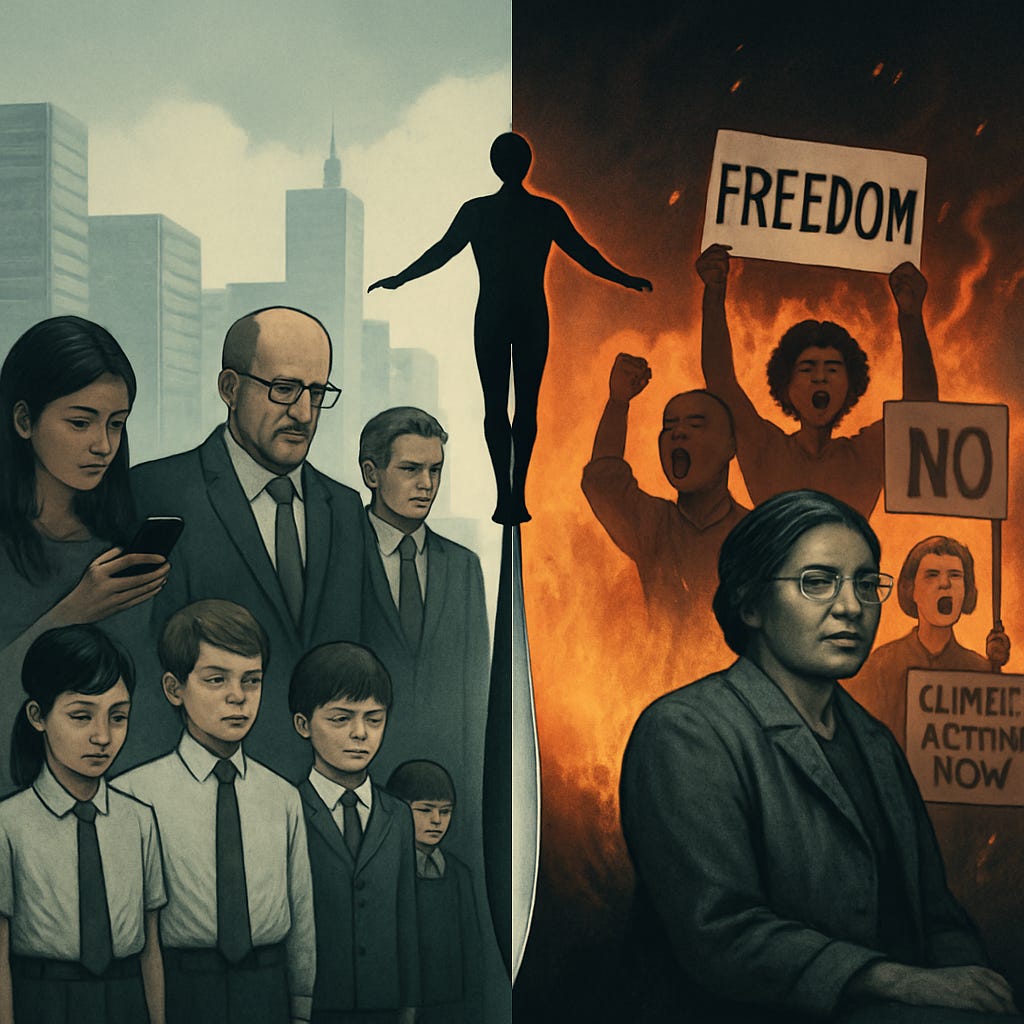
A society that equates morality with obedience manufactures citizens who are disciplined but not ethical. A society that glorifies rebellion without conscience breeds chaos without justice. Morality lives in the knife’s edge between the two.
We call it morality when we fear to disobey.
We call it rebellion when we fear to conform.
But morality is neither.
Morality is the courage to belong without losing truth.
Morality is the courage to dissent without vanity.
Morality is to obey when it nurtures,
and to defy when it destroys.
The morality in conformity is not in obedience itself….
it is in knowing when obedience becomes betrayal.
I loved this read so so much 🥹
Not just as a citizen or an individual but also at a personal level. It also hold true among friends, spaces, family, relatives etc
My obedience sometimes Is really cowardice...to not be exiled and not only it's not right, it's also affect one's mindset.
This was so so well written.
A great read!